A caddie for your crates.
It knows your bag. It reads the moment. It hands you the right one.
A floating panel that sees what's playing and tells you what to mix next — built from your library, your proven sequences, your keys, your crates and your Prepare requests. No crowd data, no cloud, no internet needed.
Club, wedding, mobile, festival, radio — if you play Serato, it learns how you play.
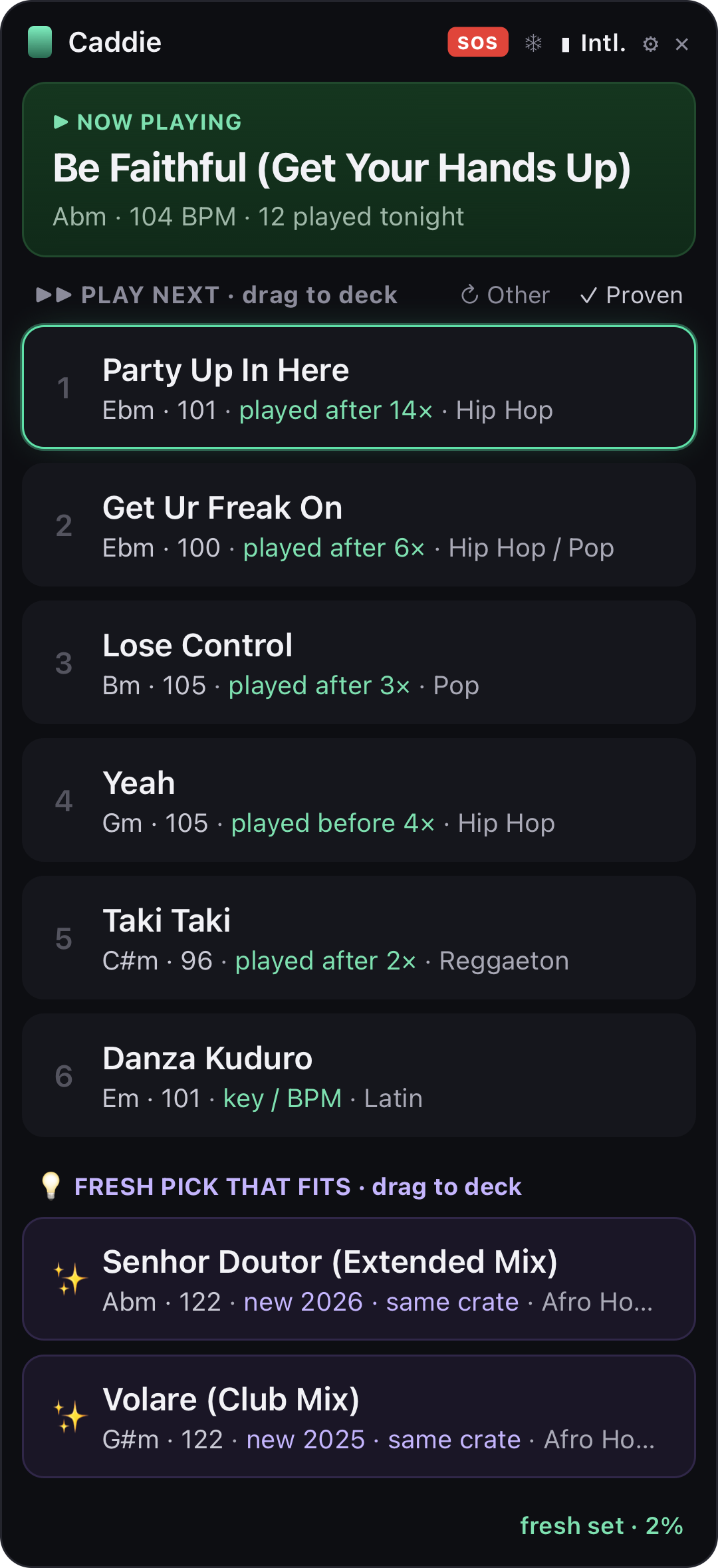
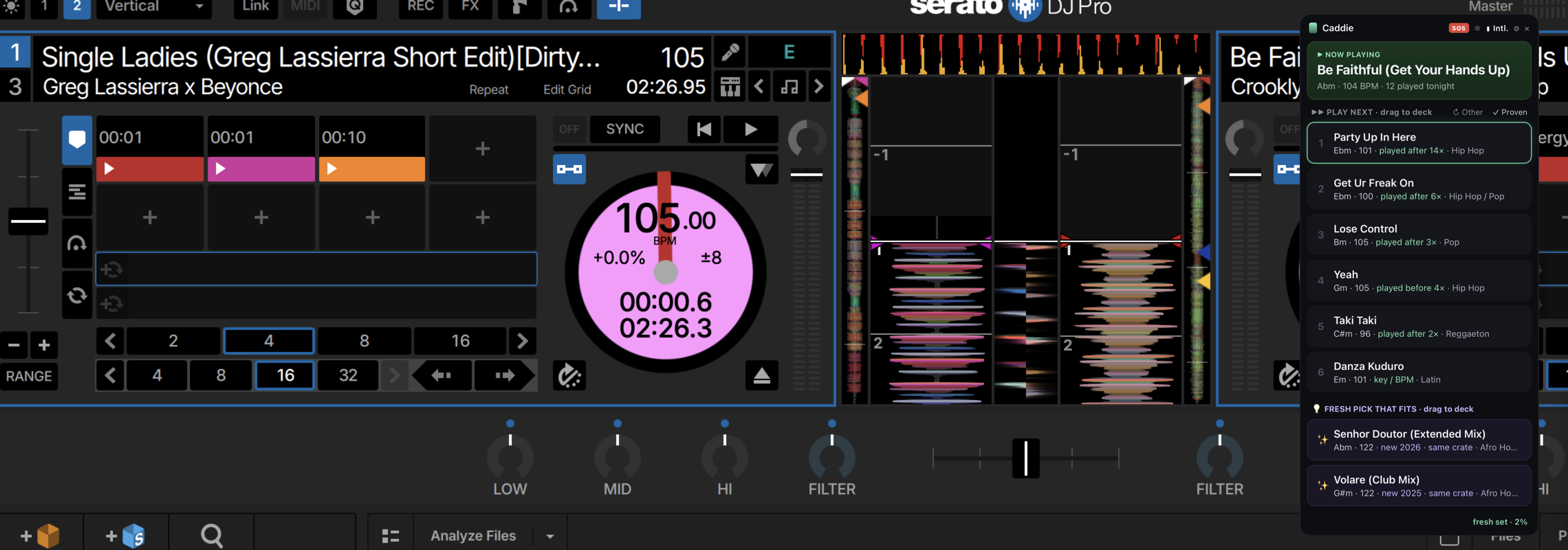
Try 3 gigs free → No card. No account. Works offline.Drag a suggestion straight onto a deck — it loads like any other file.
At 1am you have eight seconds to choose.
Your library is enormous, the floor is full, and the search box is not a plan. So you reach for what you know — and these are the real numbers from one working DJ's last eight gigs, measured from his own Serato history.
It isn't a taste problem — it's a decision problem. Give the choice to something that already knows every sequence that worked for you, and the rut takes care of itself.
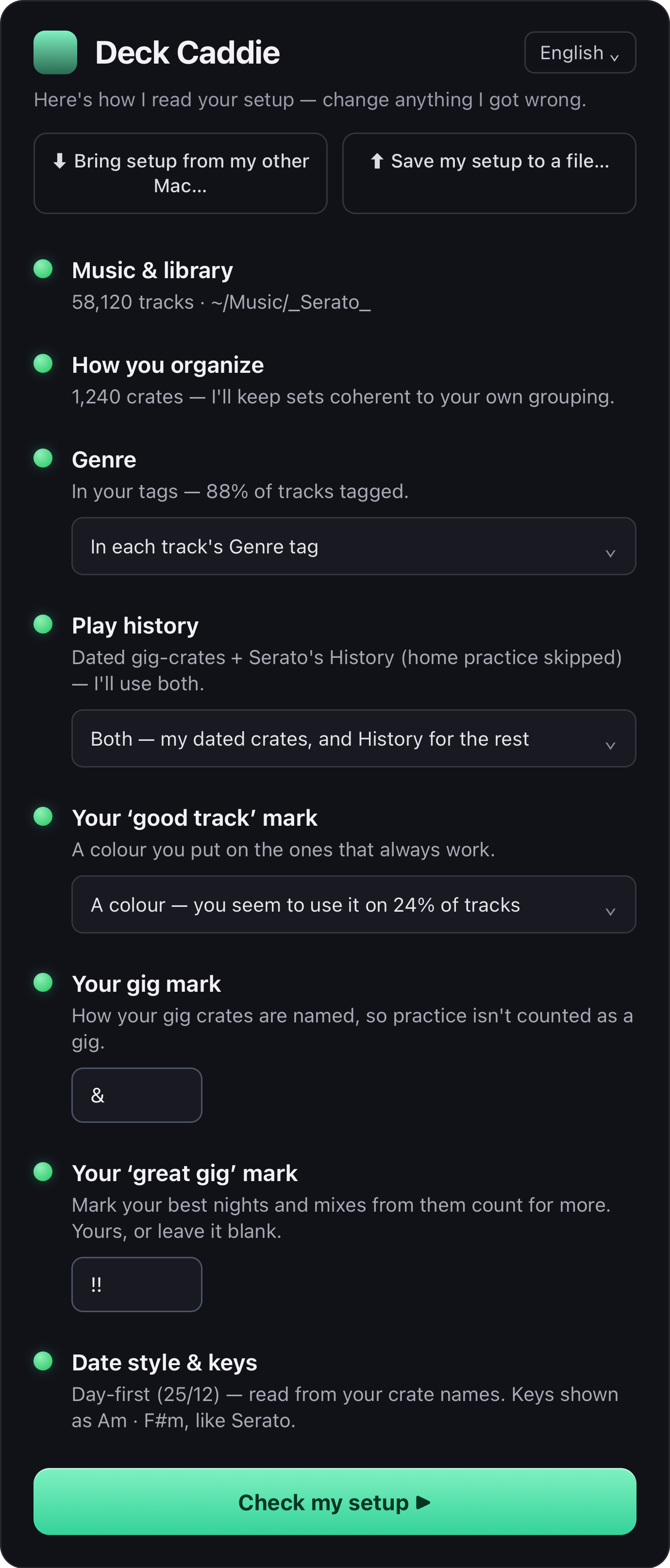
It reads how you already work, then shows you what it found.
Every DJ files music differently, and a tool that assumes one system is wrong for almost everyone. So it works yours out from the library itself — where your history lives, how you name a gig, which colour means "this one always works" — and puts every finding on screen with a light next to it, before it starts.
Nothing is hidden and nothing is guessed silently. If a light is green and the answer is wrong, you change it in a dropdown. If your own habits are unusual, the marks are yours to type — the two below are one DJ's; a "🔥", a "+", or nothing at all are equally valid answers.
Every suggestion comes from something you already did.
Your proven sequences — both directions
If you've mixed A into B before, it knows. It also counts the times you played B before A — two tracks that live next to each other in your sets are compatible in either order. Each row tells you which it was — played after 14× or played before 4× — never a vague score.
Rested, not retired
Tracks you haven't touched in 3 months to 2 years get pushed up; the ones in every recent gig get pushed down. Beyond about four years it eases off — that one probably retired on purpose.
Key, tempo, crate and genre — yours
Harmonic (Camelot) matching, BPM proximity, and your own crate and genre structure, so the set stays coherent instead of lurching between styles.
Requests that actually fit right now
Reads your Serato Prepare panel and surfaces a request only when it works with what's playing — key, tempo and style. The rest stay out of your way.
The panic button
One tap: the floor-fillers you still play — weighted by recency, so a track that killed in 2019 and hasn't since won't be suggested at your worst moment.
The morning-after report
How fresh last night actually was, how it compares to the gigs before it, the tracks you lean on every time, and what was sitting in your crates that would have fitted.
Twelve signals, weighed against each other, every few seconds.
Nothing here is a genre guess or a mood label. Every one of these is a fact about your library and your gigs, and this is the actual weighting — pulled from the engine, not written for a sales page.
| What it looks at | Where it comes from | Pull |
|---|---|---|
| You mixed this after what's playing | Your Serato history | +100 each time |
| You mixed it before it | Same — neighbours work both ways | +40 each time |
| Harmonic match | Camelot: same key, relative major/minor, or adjacent | +15 to +45 |
| Tempo sits close | Within 4 BPM, then tapering with distance | +8 |
| Same crate as what's playing | Your folder structure | +14 |
| Same genre tag | The tag on your file | +10 |
| You've been playing it lately | Overall play count | up to +6 |
| Newly added to the library | Date added, fading out over 6 months | up to +15 |
| Rested, not retired | Untouched 3 months – 2 years; eases off past 4 | up to +40 |
| Never played at all | In your crates, never once in a set | +20 |
| In every recent gig | Your crutches — pushed down, not banned | down to −40 |
| Same artist you just played | Spaced out, not blocked | down to −120 |
One slot is always kept for something fresh
Six suggestions, and the last is reserved by force for a track you've never played — or failing that, one rested at least nine months. Guaranteeing it outright is more reliable than hoping the weights work out, so the list can never quietly become the same set every weekend.
It won't offer you the same song twice
Extended mix, radio edit, that bootleg with a different title — it spots them by the rare words in the titles and blocks the lot for the night once you've played one.
It suggests tracks you've never played
Most tools can only rank what's in your history, so they can never get you out of the rut. This one pulls in harmonically compatible tracks you've never touched — the ones you bought, filed and forgot.
Filters for how the night is actually going
Your own categories, built from your genre tags and crate names, so you can narrow to what the room needs right now without leaving the panel.
Prepare requests, filtered to what fits
Read straight from Serato while it runs. Load thirty to Prepare across a night and only the ones that work with what's playing surface — compatible key, tempo within pitch range, and the same genre or crate family.
Every row says why
played after 6× key 🌱 rested 8mo never played — you can see the reasoning at a glance and overrule it. It's a caddie, not an autopilot.
It learns your scene, not somebody else's.
A tool that only understands English-language music is useless to most of the DJs on earth. Every wedding, every party has music the room knows and the algorithm doesn't — and that is exactly the music you get paid to read correctly.
So the local side is built in. Tell it where you play and it treats your local repertoire the way it deserves — the German in a Berlin club, the sertanejo in São Paulo, the laïko in Athens, the reggaeton in Bogotá — alongside everything else, never instead of it. It also reads your library's own writing system, so titles in Greek, Cyrillic, Arabic, Hebrew, Japanese, Korean or Chinese are recognised as what they are rather than filed under "foreign".
Half of every panel is a track you weren't going to play.
Anything can rank what you already play — that's the rut, with extra steps. The job is to hand you something you'd have walked past, that still works right now. So one slot in six is reserved by force for a track you've never played, and tracks resting three months to two years are pushed up while your every-gig crutches are pushed down.
Measured on a real 61,560-track library, across 1,320 actual suggestions:
It costs a little accuracy and that is the point: switch the freshness signals off and it predicts your next track better, by handing you what you'd have reached for anyway.
It knows the version you actually play.
Most working DJs don't play the release — they play their own intro cut, the transition edit, the mashup a friend sent. A tool trained on other people's parties only knows songs that charted; it has never heard of the edit sitting in your crate, so it can neither suggest it nor understand that you play it instead of the original.
This reads the actual files in your library, so an edit is simply a track like any other — with its own key, tempo and its own proven sequences.
Trained on you — not on 19,000 strangers.
Crowd-trained tools push every DJ toward the same tracks. That's the opposite of what you're paid for.
| Crowd-data tools | This | |
|---|---|---|
| Learns from | Thousands of other DJs' parties | Your library, your gigs |
| Load a suggestion | Copy the title, paste into search | Drag straight onto the deck |
| Your play data | Uploaded | Never leaves your Mac |
| Fights repetition | No — it reinforces it | It's the whole point |
| Needs internet | Yes | No. Works in any basement |
Buy it once. It's a tool, not a subscription.
Launch price · one-time · 2 Macs
- 3 full gigs free — a gig is a night you actually played
- A trial gig already under way is never cut off
- All 1.x updates included
- 30-day money-back, no questions
- Two Macs — main and backup. Activation checks in once, then never needs a connection again, so a venue's wifi can't lock you out mid-set
- Runs offline · nothing uploaded, ever
Got a code? Enter it at checkout — the discount applies before you pay.
Apple-notarised · Serato DJ Pro · macOS 11+The things you're actually wondering.
Will it interfere with my rig mid-gig?
It never touches Serato. It only reads your library files and log — one-way, read-only. It cannot modify, move or delete anything, and it makes a backup of your library before the first run anyway. It runs as a floating panel: no plugin, no driver, no hook into the software.
What if Serato changes and it breaks?
Fair question — this reads Serato's own files, so a major Serato change could affect it. If that happens, fixing it is the priority and the fix is a free 1.x update. If it can't be fixed within 30 days of a break, ask for a refund and you'll get one, however long you've owned it.
I'm new / I don't have much Serato history yet.
Then it works from key, tempo, your crates and your genre tags on day one, and gets sharper with every gig you play. It also runs fine with no colour marks and no genre tags at all — history and key alone are enough to be useful.
Does it slow my Mac down during a set?
It answers the panel in about 50 milliseconds and sits flat at roughly 240 MB with no memory growth over a long night. It's been stress-tested with a missing log, a corrupted log, a busy port and a hard kill mid-set — it keeps going or comes straight back.
rekordbox or Traktor?
Not yet — and I'd rather say so than take your money. rekordbox keeps its library in an encrypted database, so full support needs real work. Today this is a Serato DJ Pro tool.
My library lives in Dropbox / iCloud.
macOS protects those folders, so the app will ask you once for permission and walk you through it. A normal local ~/Music library needs nothing at all.